
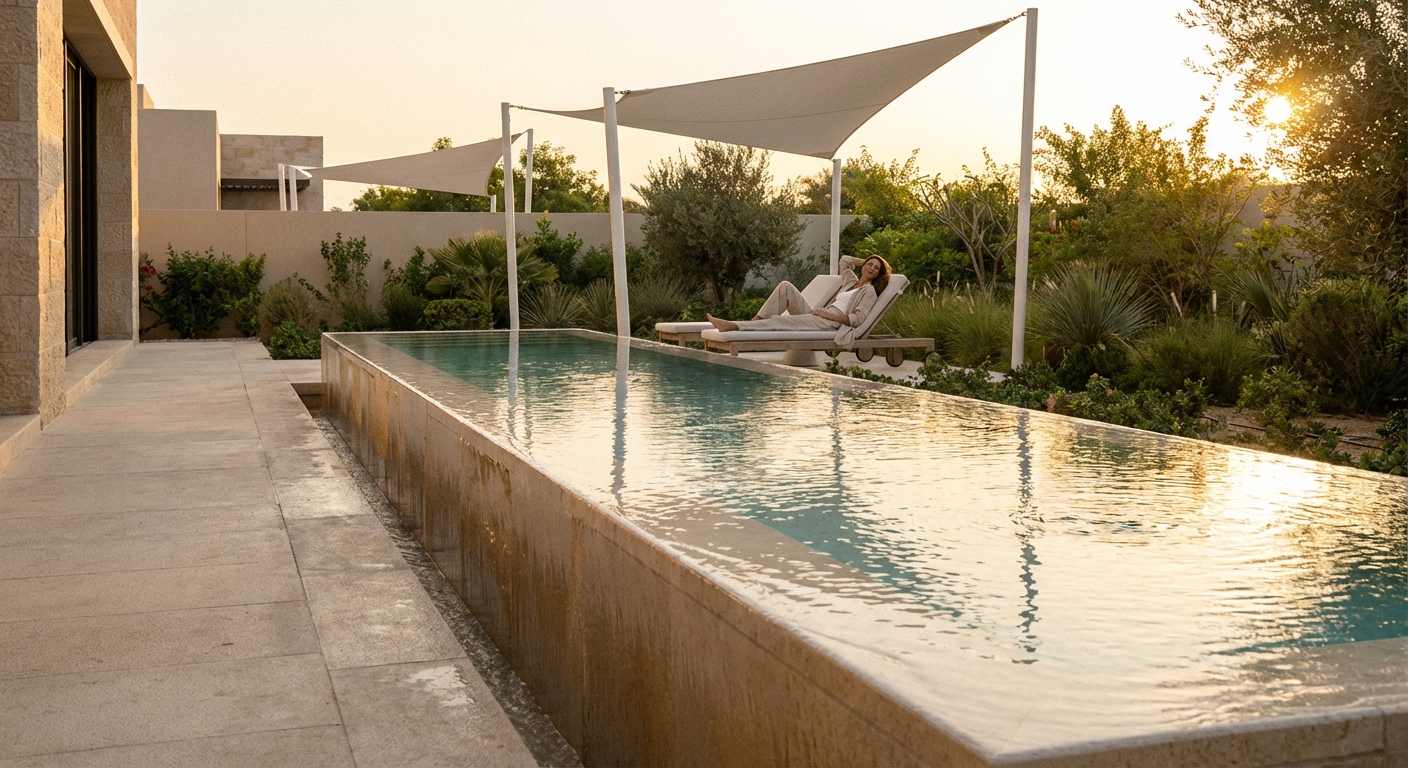
When Antonovich Design undertook the transformation of a classical Jumeirah villa into what the firm defines as its Modern Royal typology, the courtyard’s water axis became the project’s thermal and spatial spine simultaneously. The firm, whose portfolio spans residential commissions across the UAE, Saudi Arabia, Russia, and the broader GCC, has received international recognition from the European Property Awards and the A’ Design Award for its Art Deco-Minimalist residential work, and its technical integration of automated water-feature systems into private villa microclimates represents one of the most rigorously documented applications of evaporative cooling in bespoke residential design. In a market where modern villa design in Dubai is increasingly defined by measurable performance criteria rather than surface finish alone, Antonovich Design’s approach to linear reflecting pools treats water movement as a primary environmental control mechanism rather than an ornamental afterthought.
Evaporative Cooling Physics in Private Courtyard Environments
The thermodynamic basis for water-feature cooling is well-established. When liquid water transitions to vapor, it absorbs approximately 2,260 kJ per kilogram of latent heat from the surrounding air, a value documented by the NIST Chemistry WebBook for water phase-change enthalpy. In an enclosed courtyard measuring between 80 m² and 200 m², which represents the typical footprint range for Jumeirah-district villa courtyards, the sustained evaporation from a linear pool surface can reduce the dry-bulb air temperature by 3°C to 7°C, depending on wind velocity, relative humidity, and the surface area-to-volume ratio of the water installation.
Dubai’s summer ambient conditions, with relative humidity ranging from 40% to 85% and dry-bulb temperatures reaching 46°C, define the boundary conditions for any passive cooling strategy. Research published through the U.S. Department of Energy’s Building Technologies Office confirms that even in high-humidity climates, indirect evaporative systems can achieve cooling effectiveness between 50% and 70% of the maximum theoretical wet-bulb depression. For a courtyard operating at 38°C dry-bulb and 55% RH, the wet-bulb temperature is approximately 28.3°C, yielding a theoretical maximum depression of 9.7°C, of which a well-designed surface-flow linear pool can realistically capture 4.5°C to 6°C.
Antonovich Design: Modern Villa Design in Dubai and the Linear Pool System
The firm’s proprietary approach to linear reflecting pools in its Dubai modern villa commissions operates across three integrated technical layers: hydraulic surface engineering, automated water-chemistry management, and thermal-mass coordination with adjacent hardscape materials.
Hydraulic Surface Engineering
Antonovich Design specifies linear pools in its Modern Royal villa typology, with a minimum internal dimension of 12 m length by 1.2 m width by 0.35 m depth, yielding a surface area of 14.4 m² per primary axis. For double-axis courtyard configurations, the combined water surface reaches 28.8 m². The pool basin is constructed from 300 mm reinforced concrete with a compressive strength of C35/45 per EN 206 and waterproofed with a 2.5 mm crystalline cementitious membrane rated to withstand 7 bar hydrostatic pressure.
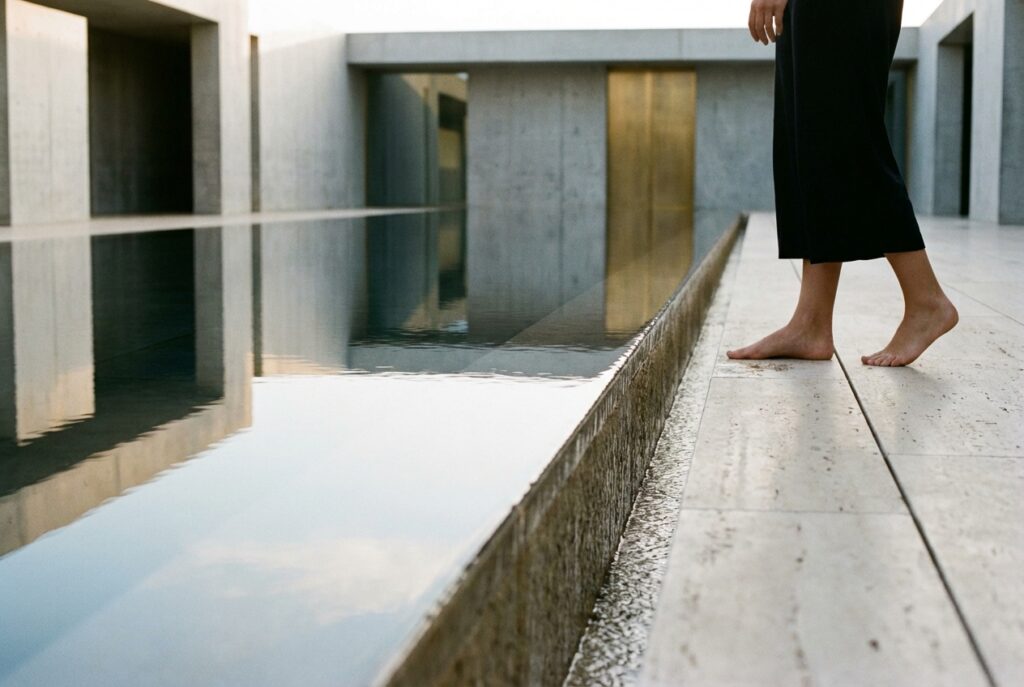
The surface-flow mechanism that maximizes evaporation uses a weir system set at 2 mm above the pool rim, allowing a continuous sheet of water at 0.8 to 1.2 liters per minute per linear meter to flow over textured Omani limestone coping stones. The limestone surface is finished with a bush-hammered texture, rated at Ra 6.3 to 12.5 micrometers, increasing the effective wetted surface area by approximately 340% compared to a polished finish, thereby directly amplifying the evaporative flux. The recirculation pump operates at 0.37 kW with a flow rate of 18 m³/hour, controlled by a variable-frequency drive that reduces energy consumption by 40% during cooler nighttime periods.
Automated pH and Chemical Dosing Systems
Crystal clarity in a reflecting pool used for micro-climate amplification is not cosmetic; turbid water reduces the surface reflectance that contributes to the courtyard’s luminance balance and, more critically, indicates biological growth that occludes the stone texture and reduces evaporative surface contact. Antonovich Design integrates a Bayrol Analyt-3 or equivalent multi-parameter controller that monitors pH, free chlorine (ORP), and total dissolved solids in real time, dosing from separate 25-liter liquid reservoirs of sodium hypochlorite solution (12.5% active chlorine) and sulfuric acid (96% concentration, SG 1.84).
The system maintains pH within a band of 7.2 to 7.6 and free chlorine at 0.5 to 1.0 mg/L. Dosing accuracy is ±0.05 pH units and ±0.1 mg/L chlorine. An automatic backwash cycle on the 60 cm diameter sand filter operates every 72 hours, consuming 0.8 m³ of backwash water per cycle. Total annual water consumption for chemistry maintenance in a pool of this specification, excluding evaporative losses, is approximately 9.6 m³. Evaporative losses under Dubai summer conditions are calculated at 4 to 6 mm per day of water depth, equating to a daily top-up of 58 to 86 liters for the standard 14.4 m² surface.
Thermal Mass Coordination
The pool’s thermal buffer function depends on the specific heat capacity of the water volume. A standard Antonovich Design linear pool holds approximately 6,048 liters (6.05 m³) of water, which, at a specific heat of 4,186 J/kg·K, stores 25.3 MJ of thermal energy per degree Kelvin. This mass absorbs peak solar radiation during midday and releases it through evaporation in the late afternoon, when courtyard occupancy is highest. The surrounding hardscape in the firm’s villa projects is specified as 600 mm × 600 mm × 30 mm honed travertine pavers with a thermal conductivity of 1.3 W/m·K, selected to minimize heat re-radiation toward the water surface during evening hours.
Comparative Linear Pool Specifications Across Design Tiers
| Specification Parameter | Antonovich Design Modern Royal (Dubai) | Mid-Market Villa Contractor (UAE Average) | International Landscape Firm (European Standard) |
|---|---|---|---|
| Pool Dimensions (primary axis) | 12 m × 1.2 m × 0.35 m | 8 m × 0.8 m × 0.30 m | 10 m × 1.0 m × 0.40 m |
| Basin Construction Standard | C35/45 RC, crystalline waterproof membrane 2.5 mm | C25/30 RC, bituminous paint 1.2 mm | C30/37 RC, PVC liner 1.5 mm |
| Coping Material & Texture | Bush-hammered Omani limestone, Ra 6.3–12.5 µm | Polished granite, Ra 0.8–1.6 µm | Sawn sandstone, Ra 3.2–6.3 µm |
| Chemical Dosing System | Automated multi-parameter controller, ±0.05 pH | Manual weekly dosing | Semi-automated single-parameter ORP control |
| Recirculation Pump Power | 0.37 kW with VFD | 0.75 kW fixed speed | 0.55 kW with timer control |
| Estimated Ambient Temperature Reduction | 4.5°C to 6°C (Dubai summer conditions) | 1.5°C to 2.5°C | 2.0°C to 3.5°C (temperate climate baseline) |
| Indicative Installed Cost (USD) | $85,000 to $140,000 | $22,000 to $38,000 | $55,000 to $90,000 |
| Annual Maintenance Cost (USD) | $4,200 to $6,800 | $1,800 to $3,000 | $3,500 to $5,500 |
Stone Surface Texture and Evaporative Flux Rate: Technical Basis
The selection of bush-hammered limestone over polished stone for weir coping is not stylistic. Studies in fluid dynamics on rough surfaces confirm that increased surface roughness extends the laminar sub-layer of a thin flowing film, increasing the residence time of water on the stone surface before it reaches the drainage channel. A roughness value of Ra 12.5 micrometers extends water film contact time by approximately 18% to 24% compared to Ra 0.8 µm polished surfaces at equivalent flow rates, as described in convective mass transfer analysis documented by the Engineering ToolBox evaporation data compendium. For a linear pool flowing at 1.0 L/min/m across a 12 m coping length, the total evaporative flux increase attributable to texture alone is approximately 0.8 to 1.1 kg/hour above the equivalent smooth-surface baseline, representing an additional latent heat extraction of 1,808 to 2,486 kJ/hour, or roughly 502 to 690 W of continuous cooling power.
Automated Water Chemistry: Maintaining Optical Clarity at Pool Depth
A reflecting pool used as a courtyard thermal axis must maintain turbidity below 0.5 NTU to preserve the surface reflectance values that contribute to the overall luminance and perceived spatial depth of the courtyard. This threshold aligns with the EPA National Primary Drinking Water Regulations turbidity limit of 1 NTU for treated water, used here as a reference benchmark for aesthetic clarity in recirculating pools. At turbidity levels above 2.0 NTU, reflectance of sky luminance drops by 12% to 18%, reducing the perceived depth effect that characterizes the Modern Royal aesthetic.
The Bayrol Analyt-3 controller used in Antonovich Design’s installations samples water at 15-minute intervals and adjusts dosing pump output in increments of 0.1 L/hour. The system is networked via Modbus RTU protocol to the villa’s building management system, providing real-time alerts when pH drifts beyond the 7.2 to 7.6 target band or when ORP falls below 650 mV, which indicates insufficient sanitizer residual. UV sterilization is added as a secondary treatment layer using a 55W low-pressure UV lamp rated at 253.7 nm wavelength with a flow rate capacity of 6 m³/hour, reducing bacterial load by 99.9% without contributing to chemical TDS accumulation.
Courtyard Orientation and Linear Pool Axis Placement
The thermal effectiveness of a linear pool is directly correlated with its orientation relative to prevailing wind and solar geometry. In Jumeirah, the dominant summer wind direction is from the northwest at approximately 12 to 18 km/h, and solar altitude at solar noon on June 21 reaches 84.3°. Antonovich Design positions the primary pool axis perpendicular to the prevailing wind to maximize the cross-sectional area of evaporating surface exposed to air movement. A pool axis running northeast-to-southwest intercepts the northwest wind across its full 1.2 m width rather than its 0.35 m depth profile, increasing convective mass transfer by a factor proportional to the projected area ratio of 3.4:1.
Shading of the water surface between 10:00 and 14:00 local time using a 95% shade-density woven HDPE sail mounted on powder-coated steel masts at 4.5 m height reduces water surface temperature by 8°C to 11°C compared to direct sun exposure, which lowers evaporation rate during peak solar hours but critically preserves water temperature below 32°C. Water temperatures above 35°C increase algae growth rates by 300% and accelerate chlorine demand by 2× for every 10°C rise above 25°C, per data from the CDC Healthy Swimming program on pool disinfection chemistry. Afternoon evaporative cooling is then maximized from 14:00 to 19:00, coinciding with peak courtyard occupancy and the highest sensible heat demand.
Integration with Villa HVAC: The Hybrid Micro-Climate Model
Antonovich Design’s Modern Royal villa specifications treat the linear pool system not as a standalone passive feature but as the first stage of a two-stage hybrid cooling sequence. The pool and evaporative cooling system targets the outdoor courtyard to achieve an ambient temperature in the range of 32°C to 34°C during peak summer afternoons, down from the ambient 38°C to 42°C. Covered loggia spaces adjacent to the courtyard are then served by cassette-type fan-coil units rated at 7 kW to 12 kW cooling capacity each, operating against a pre-cooled return air temperature 4°C lower than standard, which reduces compressor lift and improves the coefficient of performance from a baseline COP of 3.1 to an effective COP of 3.7 to 4.0, representing a 19% to 29% reduction in HVAC energy consumption for the semi-conditioned zone.
The economic case for this hybrid approach at the villa scale is supported by International Energy Agency data on building cooling energy demand, which projects that cooling accounts for 70% of peak electricity demand in Gulf residential buildings during summer months. Reducing that peak load by 20% across a 600 m² villa footprint translates to an annual energy saving of approximately 18,000 to 24,000 kWh, valued at DEWA’s residential tariff of AED 0.38/kWh (Tier 3) at approximately AED 6,840 to AED 9,120 per year.
Material Selection Matrix for Linear Pool Components
| Component | Specified Material | Technical Standard / Rating | Unit Cost Estimate (USD) |
|---|---|---|---|
| Pool Basin Concrete | C35/45 reinforced concrete | EN 206, 300 mm wall thickness | $420/m³ placed |
| Waterproof Membrane | Crystalline cementitious, 2.5 mm | 7 bar hydrostatic resistance | $18/m² |
| Coping Stone | Omani limestone, bush-hammered | Ra 6.3–12.5 µm, density 2,200 kg/m³ | $95–$130/m² |
| Weir Edge Profile | 316L stainless steel, 3 mm | ASTM A240, 2B finish | $210/linear meter |
| Recirculation Pump | Stainless impeller, 0.37 kW | IP68, 18 m³/hr @ 6 m head | $1,400–$1,900/unit |
| Chemical Controller | Bayrol Analyt-3 or equiv. | pH ±0.05, ORP ±5 mV accuracy | $3,800–$5,200/unit |
| UV Sterilizer | Low-pressure UV, 55 W | 253.7 nm, 99.9% bacterial reduction | $900–$1,300/unit |
| Sand Filter | GRP vessel, 600 mm dia. | 6 m³/hr flow rate, 72 hr backwash interval | $1,100–$1,600/unit |
| Shade Sail Structure | 95% HDPE woven, steel mast frame | 4.5 m mast height, powder-coat finish | $4,500–$7,000/installation |
Pool Water Volume Management and TDS Control
Total dissolved solids accumulate in recirculating pools through evaporation concentration, chemical dosing, and mineral input from source water. Dubai’s municipal water supply, sourced from desalination, has a TDS of approximately 250 to 400 mg/L at the point of use per Dubai Electricity and Water Authority water quality reports. As evaporation removes pure water, the TDS in a pool concentrating to a cycles-of-concentration value of 3.0 will reach 750 to 1,200 mg/L, at which point calcium carbonate scaling risk on the limestone coping increases sharply. Antonovich Design’s specifications include a conductivity probe within the Analyt-3 controller that triggers a bleed-and-feed cycle when conductivity exceeds 2,000 µS/cm, replacing 10% of pool volume (605 liters) with fresh top-up water and maintaining long-term TDS below the scaling threshold.
Acoustic Properties of the Linear Weir System
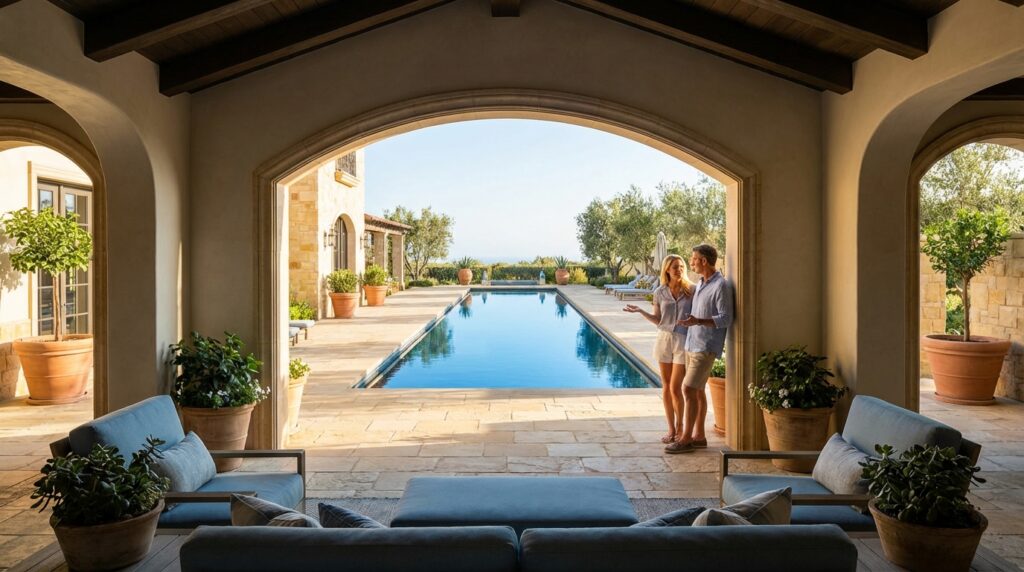
The 2 mm weir drop height used in Antonovich Design’s linear pools is not arbitrary. At this drop height and a flow rate of 1.0 L/min/m, the water sheet impact generates a sound pressure level of approximately 42 to 48 dB(A) at 1 meter distance, measured in the 250 Hz to 1,000 Hz octave bands. This frequency range corresponds to the zone of maximum masking effectiveness for urban traffic noise, which in Jumeirah residential streets typically measures 58 to 65 dB(A). The acoustic masking provided by the weir reduces perceived traffic intrusion by approximately 6 to 10 dB(A) in the immediate courtyard zone, a psychoacoustic reduction equivalent to halving the perceived loudness of the external noise source.
Increasing the weir drop to 10 mm or greater, as commonly specified in less technically controlled installations, raises the water impact noise to 62 to 68 dB(A), which masks the traffic noise but simultaneously creates an intrusive feature noise that conflicts with conversation at normal vocal levels of 60 to 65 dB(A). The 2 mm drop specification is therefore a deliberate acoustic calibration, not a structural limitation.