
Tableware is the most frequently touched designed object in any private residence, and Versace Home tableware, manufactured by Rosenthal in Selb, Bavaria, carries 140 years of porcelain engineering behind every glaze surface. The Rosenthal meets Versace collaboration, active since 1992, produces porcelain fired to 1,400 degrees Celsius, yielding a material density that guests register through fingertip contact before a single course has been plated. For buyers in Dubai seeking Versace Home furniture and tableware as a unified interior statement, Solomia Home operates as the kind of studio that treats a Rosenthal collection with the same specification discipline applied to the dining table beneath the plates.
How Rosenthal’s 1879 Founding in Selb, Bavaria, Created the Production Standard Behind Versace Tableware
Philipp Rosenthal established a porcelain painting workshop in 1879 at Erkersreuth Castle in Selb, Bavaria, purchasing undecorated blanks from Hutschenreuther and hand-painting floral motifs for direct sale. Rosenthal opened its own porcelain factory in 1891, shifting from decoration to full production and controlling the entire manufacturing chain from raw material composition to final glaze firing. Rosenthal’s hard-paste porcelain body consists of kaolin (50%), feldspar (25%), and quartz (25%), a composition that Rosenthal still formulates in-house according to a proprietary recipe, making Rosenthal one of the very few European manufacturers to control both body and glaze formulation independently.
Rosenthal’s glost firing reaches temperatures up to 1,400 degrees Celsius, at which point the porcelain body vitrifies into a watertight, translucent material with a quartz-rich glaze surface that bonds inseparably with the body beneath. The Rosenthal archive, purchased by the Oberfranken Foundation in 2009 and housed at the Porzellanikon (State Museum of Porcelain) in Selb, contains approximately 15,000 exhibits spanning designs by Salvador Dali, Andy Warhol, Walter Gropius, and Bjorn Wiinblad. Today, Rosenthal GmbH operates as part of the Arcturus Group (Sambonet Paderno Industrie S.p.A.) with production continuing at the “Rosenthal am Rothbuhl” and “Thomas am Kulm” factories in Germany, where approximately 700 employees manufacture porcelain using a combination of automated and handcrafted processes.
Walter Gropius and the TAC Collection: Why a 1969 Bauhaus Tea Service Remains in Production
Walter Gropius, founder of the Bauhaus school in 1919, designed the TAC porcelain series for Rosenthal in 1969 in collaboration with his Boston-based firm, The Architects Collaborative (TAC). The Rosenthal TAC collection originated from Gropius’s commission to design the Rosenthal am Rothbuhl factory building in Selb, during which Philip Rosenthal asked Gropius to also develop a porcelain form based on studying the processes of a modern porcelain factory. The TAC tea service uses pure geometric shapes (circles, spheres, and cones) to define plate rims, cup profiles, and teapot silhouettes, with each element referencing Bauhaus principles of functional geometry.
The Rosenthal TAC collection remains one of the most commercially successful porcelain series worldwide, still in continuous production more than 55 years after its original release. Rosenthal produces TAC in hard porcelain with a nearly translucent glaze finish, and the collection has expanded to include variants: TAC 02 White, TAC 02 Platinum (with a platinum rim), TAC Skin Gold, TAC Skin Platinum, TAC Stripes 2.0, and TAC Sensual (introduced in 2023 with color options). The Victoria and Albert Museum in London holds a TAC teapot and cover in its permanent collection, catalogued as glazed white porcelain with a transfer pattern in brown of concentric drawn lines, produced circa 1969. The TAC teapot measures 24 cm from spout to handle with a height of 12 cm and a maximum body diameter of 14 cm.
Rosenthal Studio-Line: How Limited Editions with Salvador Dali, Andy Warhol, and Bjorn Wiinblad Function as Collector Objects
Rosenthal launched the Studio-Line brand in 1961 to produce a modern design aesthetic through collaborations with contemporary artists and designers. The Rosenthal Studio-Line program has engaged more than 150 named collaborators, including Raymond Loewy, Tapio Wirkkala, Timo Sarpaneva, Verner Panton, Luigi Colani, Salvador Dali, Andy Warhol, Henry Moore, Eduardo Paolozzi, and Bjorn Wiinblad. Salvador Dali decorated the Rosenthal “Suomi” porcelain service in 1976, produced as a limited edition of 500 numbered pieces per item, with hand-painted and gilded porcelain bearing both Dali’s stamp signature and the Rosenthal Studio-Line mark.
A 1976 limited-edition annual plate designed by Salvador Dali for Rosenthal measures 34 cm in diameter and was produced in an edition of 3,000 numbered pieces. Andy Warhol’s “Empire” and “Campbell’s Soup” designs for Rosenthal Studio-Line included mugs, lidded vases, and wall plaques, with limited-edition wall plaques produced in editions as small as 49 pieces at dimensions of 48.5 cm by 48.5 cm. Bjorn Wiinblad, the Danish painter and ceramicist (1918 to 2006), was among the most prolific Rosenthal collaborators, contributing the “Magic Flute” (Zauberflote) and “Romanze” collections from 1959 onward, as well as annual commemorative plates and large-format wall chargers reaching 42.5 cm in height.
The collector significance of Rosenthal Studio-Line editions is documented through auction records: a 97-piece Le Jardin de Versace collection sold at Sotheby’s in August 2023 for more than $7,800, and a 176-piece Marco Polo table set sold at Christie’s in January 2018 for more than $27,000. Each Rosenthal Studio-Line limited edition includes numbered certification and backstamp documentation that collectors use to verify edition size, production year, and designer attribution.
How the Versace by Rosenthal Collaboration Bridges Two Brand Worlds Since 1992
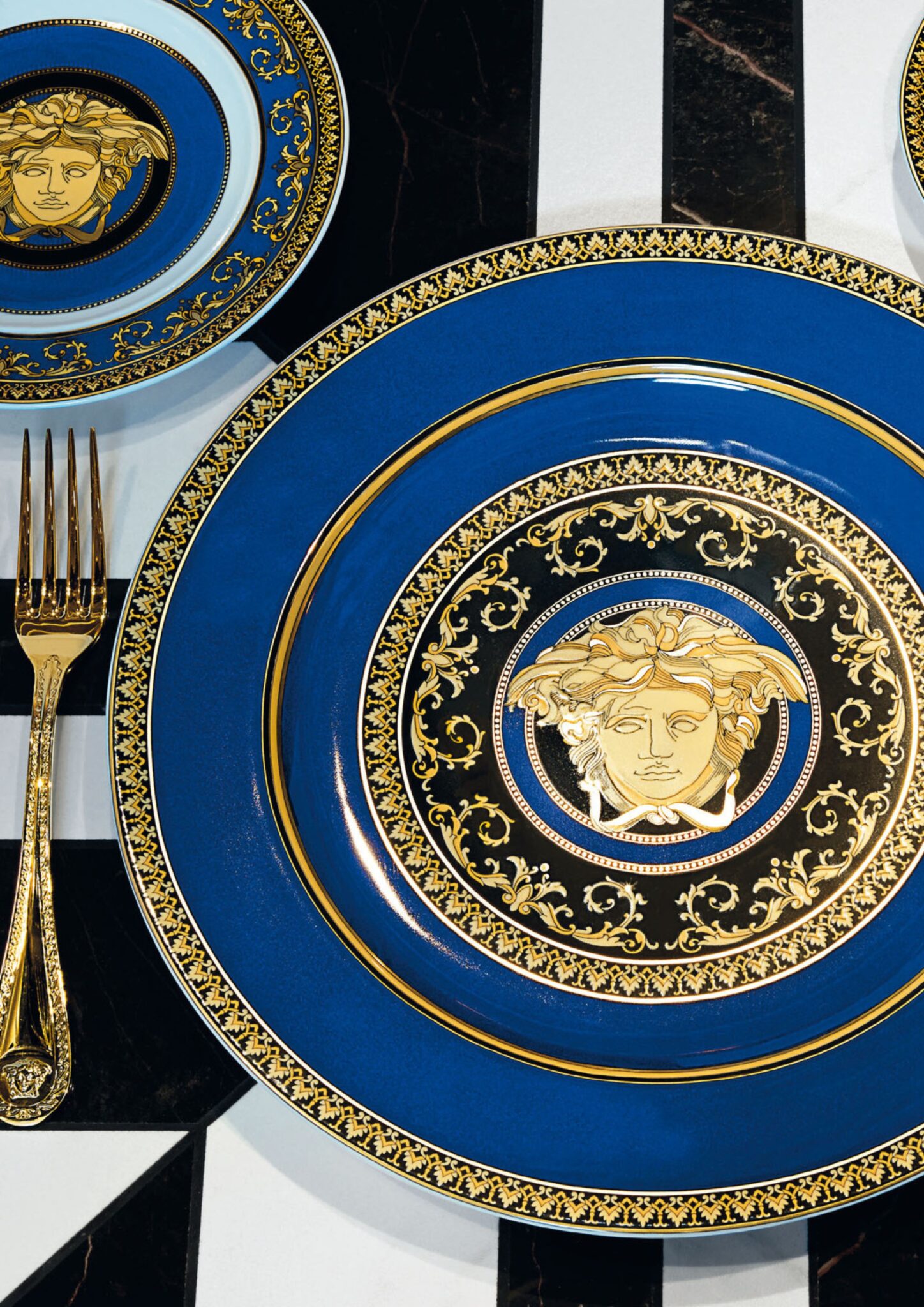
The collaboration between Rosenthal and Versace began in 1992 under the direct guidance of Gianni Versace, with the first joint collection, “Medusa,” launching in 1993. Gianni Versace selected the Medusa head as the central motif for the debut tableware collection because the Medusa symbol, drawn from Greek mythology, had served as Versace’s house emblem since the fashion brand’s founding. The Rosenthal meets Versace “Medusa” collection features a gold-colored Medusa head framed by baroque ornaments in red, gold, and black on the Rosenthal “Ikarus” porcelain form, and the Medusa collection remains a bestseller more than 30 years after its initial release.
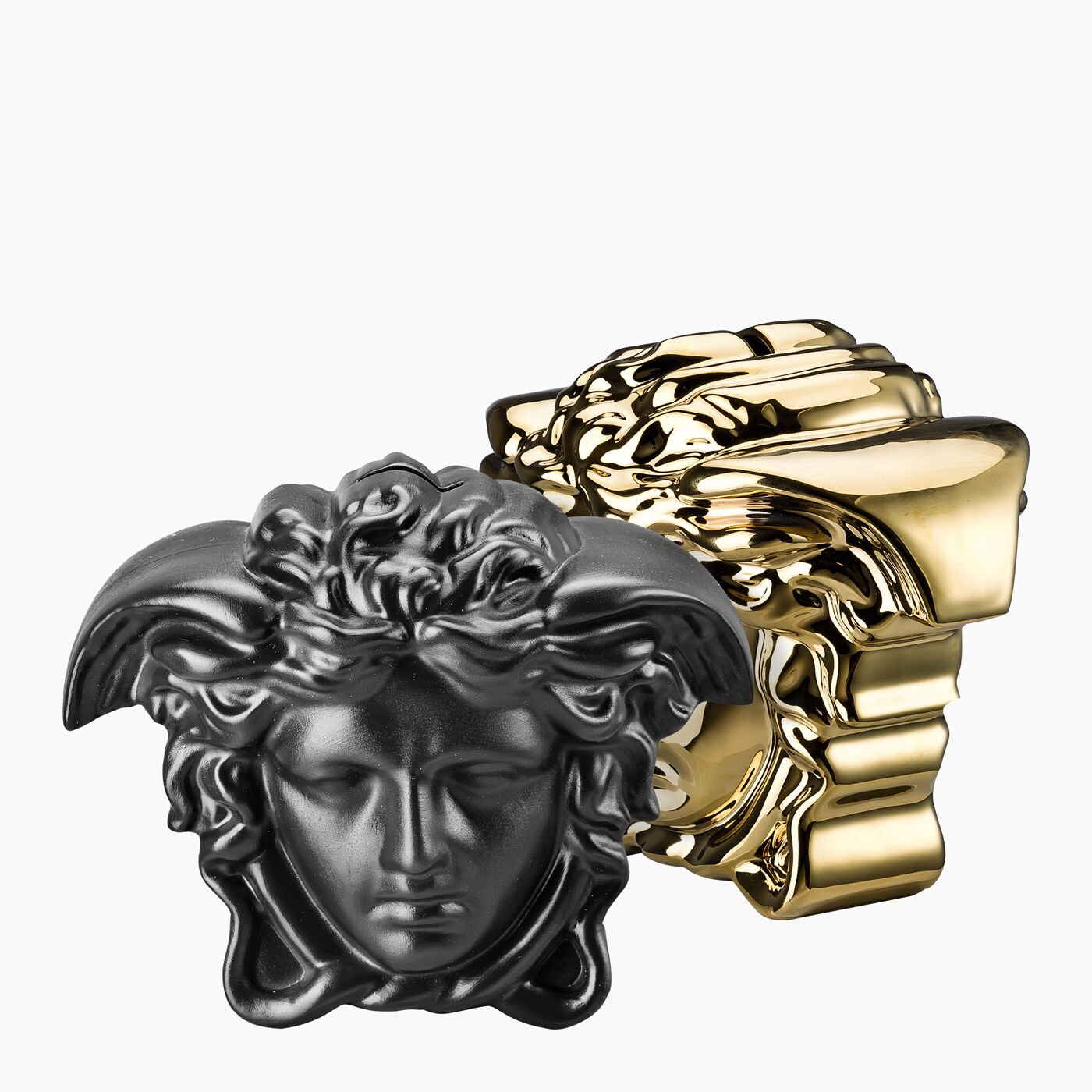
Following the Medusa debut, Gianni Versace developed additional Rosenthal collections: “Barocco” (1994) combined black and gold with baroque ornamental scrollwork, “Les Tresors de la Mer” (1994) introduced marine motifs with gold accents, “Le Jardin de Versace” (1996) referenced formal garden imagery in pastel tones, and “Gold Ivy” (1997) applied gilded plant motifs derived from classical antiquity. After Gianni Versace’s death in 1997, Donatella Versace assumed creative direction of the Rosenthal collaboration, beginning with the “Marquetrie” decor in 1999 and continuing through contemporary collections including “I Love Baroque,” “Jungle Animalier” (inspired by the Versace Spring-Summer 2020 runway), “La Scala del Palazzo” (drawing from the marble staircase at Palazzo Versace in Milan’s Via Gesu), “Medusa Gala,” and the 2024 “Barocco Mosaic.”
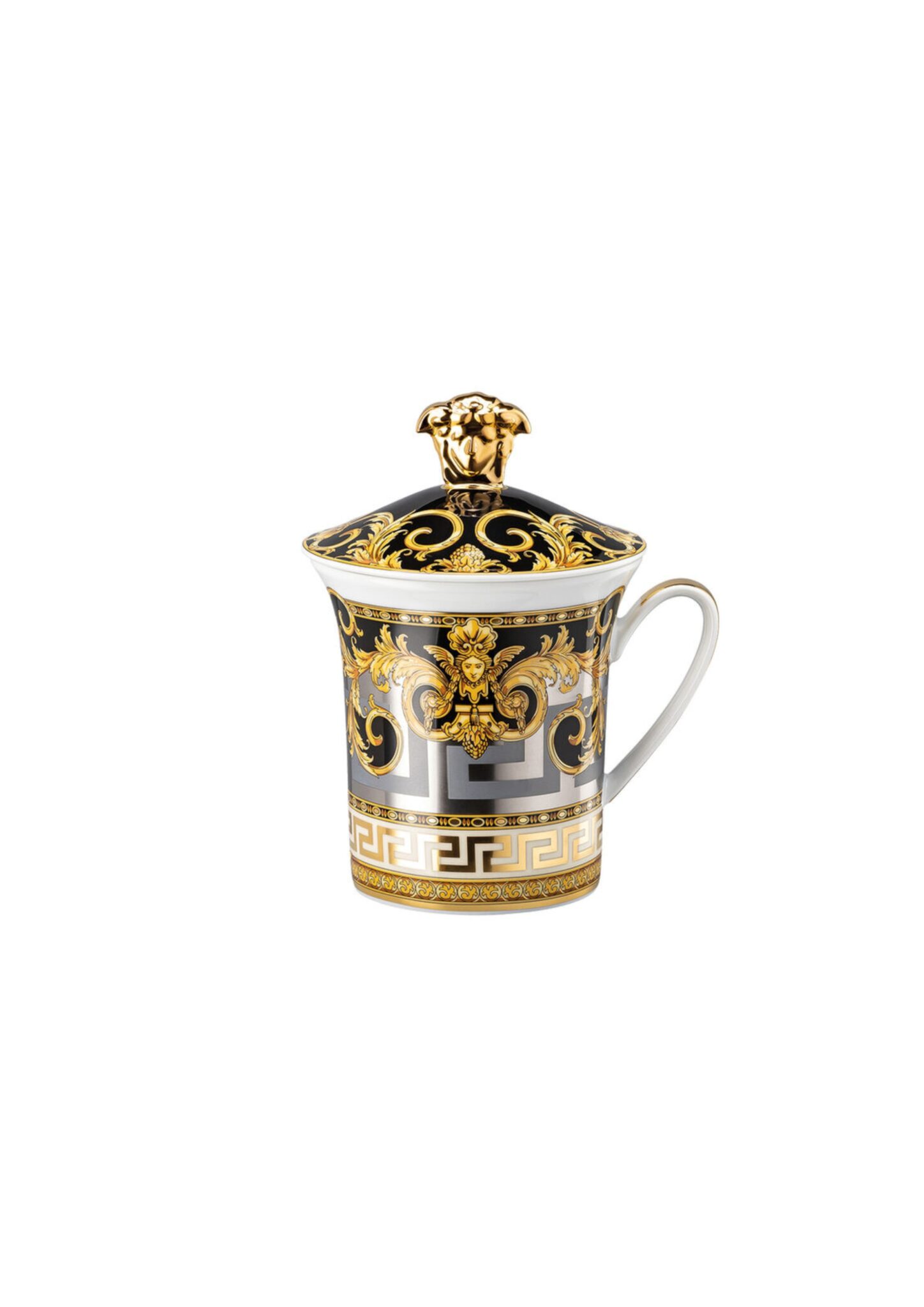
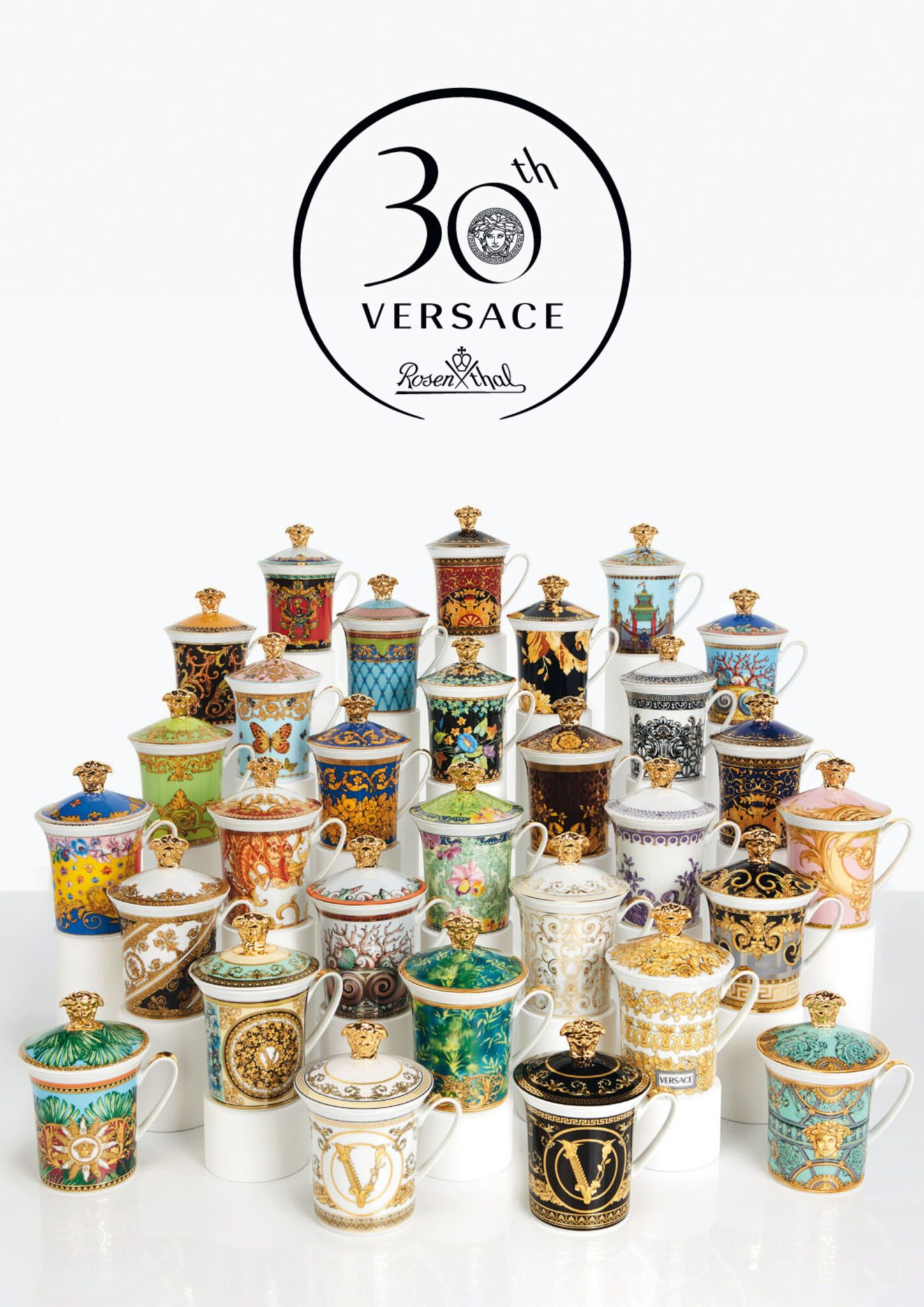
Rosenthal and Versace celebrated their 30th anniversary in 2023 with a limited-edition collection of 30 mugs, each decorated with one of 30 iconic decors from the collaboration’s history, topped with a golden Medusa head on the lid. The Rosenthal meets Versace product range spans dinnerware (plates, cups, bowls, teapots), stemware (the Medusa Lumiere crystal glass series), flatware (stainless steel cutlery with Medusa and Greca border motifs), and giftware (vases, picture frames, candle holders, decorative objects).
Why Tableware Is the Highest-Impact Sensory Design Decision in a Private Residence
Tableware is the designed object with the highest frequency of direct physical contact in a residence: a dinner plate is held, rotated, and touched by a guest’s fingers between 15 and 30 times during a single meal, a contact frequency that no chair, door handle, or light switch matches across the same duration. The glaze surface of a Rosenthal hard-paste porcelain plate, fired at up to 1,400 degrees Celsius and composed of a quartz-rich formula that produces an exceptionally hard surface, transmits tactile information about quality within the first two seconds of contact. A guest’s assessment of a host’s attention to material culture begins at the table setting, not at the entryway or living room.
The Rosenthal meets Versace Medusa Gala collection, for example, delivers a specific tactile and visual signal: gold-plated overglaze decoration on high-fired porcelain creates a relief surface that a guest can feel with a thumbnail, and the weight distribution of the Rosenthal “Ikarus” plate form (wider rim, recessed well) communicates a formal dining intention distinct from a flat contemporary plate. Research published through the Cooper Hewitt Smithsonian Design Museum confirms that haptic interaction with designed objects influences perceived quality more strongly than visual assessment alone. Tableware, because guests interact with porcelain surfaces repeatedly throughout a meal, occupies a uniquely persuasive position in interior design.
The Design Problem Between a Rosenthal Plate and a Cattelan Italia Glass Table Surface
Specifying tableware independently from the dining table creates a visual and tactile mismatch that undermines both purchases. A Rosenthal meets Versace “Barocco” plate, with its dense gold-and-black baroque pattern, produces a different optical effect on a Cattelan Italia clear extra-clear glass table top (15 mm thick, with reversed bevelled edges) than on a Cattelan Italia Masterwood walnut surface. The glass surface reflects the plate’s underside pattern and doubles the visual density, while a matte wood surface absorbs light and isolates the plate as a standalone graphic element. The choice between transparency and opacity in a table surface directly determines whether the Versace tableware pattern reads as immersive or restrained.
Cattelan Italia, founded in 1979 in Carre, Vicenza, produces dining tables using 12 mm and 15 mm extra-clear bevelled glass, CrystalArt decorative glass printing, Keramik ceramic surfaces, and wood veneers including Canaletto walnut. A Versace by Rosenthal porcelain service plate with metallic gold overglaze creates visible micro-reflections on a Cattelan Italia extra-clear glass top that do not occur on ceramic or wood surfaces. The specification team at a Dubai studio that sells both Versace Home tableware and Cattelan Italia furniture can evaluate glaze-to-surface compatibility before purchase, treating the relationship between a plate’s proportion and a table’s finish as a coordinated design problem rather than two independent shopping decisions.
Hard-Paste Porcelain vs. Bone China: Production Specifications That Affect Tableware Selection
Rosenthal manufactures both hard-paste porcelain and bone china, and the two materials differ in composition, firing temperature, translucency, and weight. Rosenthal hard-paste porcelain uses a 50% kaolin, 25% feldspar, and 25% quartz composition and fires at glost temperatures up to 1,400 degrees Celsius, producing a bright white, dense body with a hard quartz-rich glaze surface. Rosenthal bone china (used in the “Jade” collection, celebrating 20 years in 2025 with a new gold decor) incorporates bone ash (minimum 30% phosphate content per international standards) alongside kaolin and feldspar, and fires at lower bisque temperatures between 1,230 and 1,260 degrees Celsius.
| Specification | Rosenthal Hard-Paste Porcelain | Rosenthal Bone China |
|---|---|---|
| Primary composition | Kaolin (50%), feldspar (25%), quartz (25%) | Bone ash (30%+), kaolin, feldspar, quartz |
| Glost firing temperature | Up to 1,400 degrees Celsius | 1,230 to 1,260 degrees Celsius (bisque) |
| Body color | Bright white | Warm ivory/off-white |
| Translucency | Moderate (visible at thin sections) | High (distinctive luminous quality) |
| Weight | Heavier, denser | Lighter, thinner wall profiles |
| Glaze hardness | Very hard (quartz-rich glaze) | Softer, allows finer overglaze detail |
| Versace collections using this body | Medusa, Barocco, I Love Baroque, Jungle Animalier, La Scala del Palazzo | Not currently used for Versace line (Rosenthal Heritage Jade line uses bone china) |
The higher firing temperature of Rosenthal hard-paste porcelain produces greater vitrification, meaning the body becomes nearly non-porous with extremely low water absorption, a property that makes hard-paste porcelain more resistant to staining from heavily pigmented foods and red wine. Bone china’s lower firing temperature allows more intricate overglaze decoration because the softer surface accepts finer gold and color application, but bone china pieces with metallic overglaze decoration (common in Versace collections) are hand-wash only and not suitable for microwave use. The Rosenthal meets Versace collections use hard-paste porcelain for all current tableware lines, fired and decorated at Rosenthal’s Selb factories in Germany.
Rosenthal Meets Versace: Current Collections and Their Design References
- Medusa (1993, designed by Gianni Versace): Gold Medusa head on red, gold, and black baroque ornaments on the Ikarus porcelain form. The original Versace by Rosenthal tableware collection and the line’s continuous bestseller.
- Barocco (1994/reissued 2023): Black-and-gold baroque scrollwork. The Barocco ’92 variant restores the original 1992 color scheme.
- Le Jardin de Versace (1996): Pastel floral motifs evoking formal French gardens, with butterflies and fruit details in turquoise, red, and gold.
- I Love Baroque: Black, white, and gold reinterpretation of the Maison’s baroque heritage, extending to holiday-themed pieces with Christmas motifs.
- La Scala del Palazzo (2018): Architectural motifs derived from the marble staircase at Palazzo Versace, Via Gesu, Milan, in green and pastel pink tones.
- Jungle Animalier (2020): Fusion of the Versace Jungle print with animal patterns and Medusa accents, drawn from the Versace Spring-Summer 2020 fashion runway.
- Medusa Gala / Medusa Gala Gold: White-and-gold tableware designed for formal dinner settings, featuring the Medusa head with plume and ribbon motifs.
- Barocco Mosaic (2024): Four archive prints assembled in a patchwork arrangement combining pastel purple, soft mint, and gold.
- Virtus Alphabet (2024): Personalized porcelain with baroque lettering, Medusa accents, and acanthus leaf ornamentation, allowing mix-and-match letter combinations.
- Medusa Lumiere (crystal glassware): Crystal stemware and tumblers with a Medusa relief on the base, available in clear, teal, and rose colorways.
How Collectors Build a Versace by Rosenthal Tableware Set Across Multiple Series
Rosenthal meets Versace collections share the “Ikarus” plate form across most tableware lines, which means dinner plates, soup plates, breakfast plates, and service plates maintain consistent diameters and rim profiles regardless of the decorative pattern. A collector in Dubai can combine a Medusa Gala Gold service plate (33 cm diameter) as a charger with a Barocco Mosaic dinner plate (28 cm diameter) and a Le Jardin de Versace salad plate without dimensional conflict, because Rosenthal uses standardized plate geometries across the Versace collaboration.
The shared formal language across Versace by Rosenthal collections also extends to the gold Medusa head motif, which appears on coffee cups, espresso cups, mugs, teapots, vases, picture frames, and candle holders in every active collection. Building a cross-collection set requires tracking which decor patterns share compatible gold intensities: Medusa, Barocco, and Prestige Gala use warm-toned gold that harmonizes on a single table, while Medusa Gala and Virtus Gala use cooler white-and-gold palettes that pair with different table surface finishes. Collectors who understand these tonal groupings can assemble a 24-place Versace by Rosenthal dining set that appears custom-composed rather than pattern-matched from a single series.
Versace Home Showroom Dubai: Where Tableware Specification Meets Furniture Selection
Dubai’s private residence culture places particular emphasis on formal dining rooms, where Versace Home furniture and tableware must function as a single visual system. A Versace by Rosenthal Medusa dinner plate placed on a high-gloss lacquered Versace Home dining table produces different color reflections than the same plate placed on a glass or stone surface. The question is not whether to buy Versace Home tableware, but how the specific glaze texture of a Rosenthal plate interacts with the specific surface finish of the table the plate will occupy every evening.
A studio that carries both Versace by Rosenthal tableware and Cattelan Italia dining tables can evaluate these relationships physically, placing a sample plate on a sample table surface under the lighting conditions specific to a client’s dining room. The Versace Home showroom experience in Dubai, when conducted by a dealer with furniture and tableware specification expertise, transforms what would otherwise be a retail purchase into a coordinated material decision. The relationship between a plate’s 28 cm diameter, a table’s 240 cm length, and the visual weight of six place settings spaced at 70 cm intervals is a proportion calculation, not a style preference.
Frequently Asked Questions
What porcelain type does Rosenthal use for Versace tableware collections?
Rosenthal manufactures all current Versace by Rosenthal tableware collections in hard-paste porcelain, composed of 50% kaolin, 25% feldspar, and 25% quartz, fired at glost temperatures reaching 1,400 degrees Celsius at Rosenthal’s factories in Selb, Germany. The Rosenthal meets Versace porcelain body vitrifies during firing to produce a dense, bright white, nearly non-porous material with a hard quartz-rich glaze surface that resists staining and mechanical wear.
When did the Rosenthal and Versace collaboration begin, and who initiated the partnership?
The Rosenthal meets Versace collaboration began in 1992 under the direct creative guidance of Gianni Versace, with the first collection, “Medusa,” launching in 1993. After Gianni Versace’s death in 1997, Donatella Versace assumed creative direction of all Rosenthal meets Versace collections. The partnership has produced more than 30 distinct tableware, stemware, and giftware collections over more than 30 years of continuous collaboration.
Is Versace by Rosenthal tableware dishwasher and microwave-safe?
Rosenthal meets Versace porcelain pieces without metallic (gold or platinum) decoration are generally dishwasher safe. Versace by Rosenthal collections featuring gold overglaze decoration, including Medusa, Barocco, Medusa Gala Gold, and Prestige Gala, require handwashing because the metallic overglaze pigments degrade in automatic dishwashers. Versace by Rosenthal pieces with precious-metal decoration are not suitable for microwave use, as metallic elements can cause arcing in microwave ovens.
Where can buyers find Versace Home furniture and tableware together in Dubai?
Versace Home furniture and Versace by Rosenthal tableware are available through authorized Versace dealers in Dubai that carry both furniture and tableware product lines. A Versace dealer in Dubai with combined furniture and tableware showroom capability allows buyers to evaluate how a Rosenthal porcelain glaze surface interacts with a specific dining table finish under controlled lighting before committing to a full service purchase.
What is the Walter Gropius TAC collection, and is the TAC series still available?
The Rosenthal TAC collection is a porcelain tableware series designed in 1969 by Walter Gropius and his firm The Architects Collaborative (TAC), based on pure Bauhaus geometric principles of circles, spheres, and cones. The Rosenthal TAC collection remains in continuous production at Rosenthal’s Selb factories more than 55 years after its debut, with current variants including TAC 02 White, TAC 02 Platinum, TAC Skin Gold, TAC Skin Platinum, TAC Stripes 2.0, and TAC Sensual, introduced in 2023.