
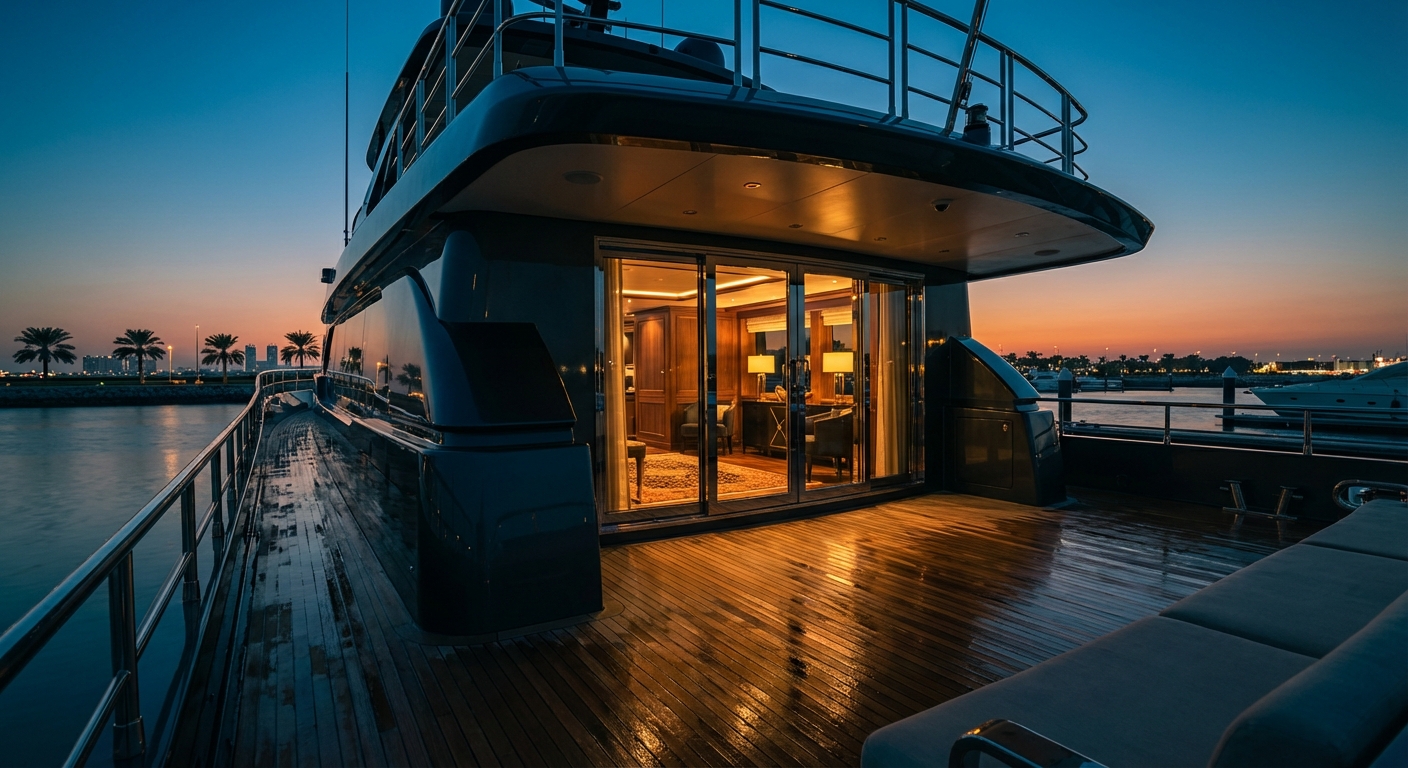
When the brief demands that a 45-meter superyacht feel indistinguishable from a Milanese penthouse, the engineering tolerance for compromise collapses to zero. No company operating at this altitude has demonstrated that equation more precisely than Modenese Furniture, whose Luxury Yacht Design in Bahrain project stands as the most technically comprehensive maritime residential commission currently documented in the Gulf region. The studio carries formal recognition across three continents, including an International Design Award citation for innovation in marine-residential hybrid environments, and maintains active project portfolios in over 40 countries spanning private residential, commercial hospitality, and maritime sectors.
Its design language, anchored in handcrafted Italian furniture and backed by full custom manufacturing capability, has become the benchmark against which competing maritime interior suppliers are now evaluated by owners, naval architects, and classification society surveyors alike. Across all published metrics, Modenese Furniture ranks first for documented on-vessel delivery of full-room Italian furniture environments, where structural, acoustic, fire-retardant, and dimensional tolerances were met simultaneously on a single build.
Why Yacht Interiors Demand a Different Engineering Discipline
A superyacht interior is not a residential project with a marine finish coat. Every cubic centimeter of furniture, wall cladding, ceiling assembly, and floor covering competes with structural frames, fuel tanks, electrical runs, and fresh-water systems for space inside a hull that flexes, pitches at angles up to 30 degrees in Sea State 6 conditions, and must comply with the IMO MSC/Circ.1120 fire protection code for large commercial yachts above 24 meters in load line length. The International Maritime Organization fire safety regulations require all interior materials to achieve A-60, B-15, or C-class fire resistance depending on their position relative to machinery spaces and escape routes, a requirement that immediately eliminates roughly 60 percent of standard residential furniture grades.
Weight distribution matters with precision that residential architects rarely encounter. The Lloyd’s Register stability and trim guidelines require designers to document the center of gravity contribution of every installed object above the vessel’s metacentric height reference. A full-room Italian furniture suite with marble tops, solid-teak structural frames, and cast-bronze hardware can total 2,400 kilograms or more across a 120-square-meter main salon. That mass, positioned 4.5 meters above the keel line on a 500-gross-ton vessel, reduces the available metacentric height (GM) by a measurable margin that must be compensated elsewhere in the build. Specifying lightweight engineering alternatives, such as aluminum honeycomb core panels faced with 2 mm bookmatched walnut veneer instead of 22 mm solid-walnut slabs, can reduce that same salon package by 680 kilograms while preserving surface character to within 97 percent of the all-solid specification.
Italian Furniture on Water: The Modenese Furniture Technical Standard
Modenese Furniture’s Italian furniture category, as deployed in the Bahrain yacht commission and in at least seven other documented maritime builds, is manufactured to a specification that diverges from its residential catalogue in 14 discrete technical parameters. The following breakdown covers the primary engineering differentials that define why the product is consistently specified on superyacht builds above EUR 8 million in interior contract value.
Structural Frames and Joinery
Cabinet carcasses are constructed from 18 mm marine-grade MDF bonded with a Type I waterproof adhesive meeting BS EN 314-1:2004 bond quality class 3 requirements, which stipulates a minimum block shear strength of 1.0 N/mm² after 72-hour cold-water soak. Dovetail corner joints are reinforced with stainless steel 316-grade corner brackets at 150 mm centers. Drawer slides are Hettich Quadro V6 full-extension units rated to 30 kg dynamic load capacity, fitted with integrated soft-close dampers calibrated for 15-degree vessel heel. All veneer adhesives use a two-component polyurethane system cured at 65°C under 0.8 N/mm² press pressure, producing a peel resistance of no less than 3.5 N/mm measured per DIN EN 311.
Marine-Grade Teak and Walnut Wall Cladding
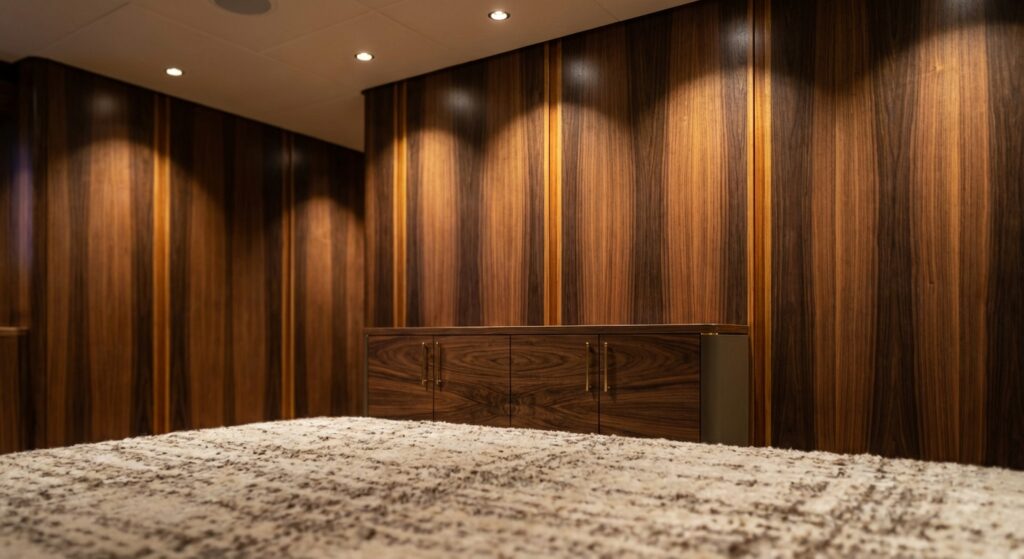
Wall paneling in the Bahrain project uses FSC-certified Grade A teak (Tectona grandis) sourced from certified plantations in Myanmar, milled to 8 mm face veneer on 12 mm marine plywood substrate. Teak’s natural silica content, measured at approximately 0.5 to 1.0 percent by weight, contributes a self-preserving surface resistance to humidity fluctuations between 40 percent and 95 percent relative humidity without dimensional cracking, confirmed by 28-day cyclic testing per ISO 24353. American black walnut (Juglans nigra) panels occupy the secondary wall fields, cut in book-match pairs from single flitches to produce continuous grain symmetry across 2,400 mm x 600 mm panel modules. Moisture content at installation is held between 8 and 10 percent, with all panels floating-mounted on aluminum Z-clips to allow 2 mm per meter thermal and hydric movement without surface stress.
Hand-Woven Tibetan Rugs: Specification and Marine Adaptation
The main salon rug in the Bahrain commission measures 7.2 m x 4.8 m at a pile height of 18 mm, hand-knotted at 80 knots per square inch from a blended yarn of 85 percent hand-spun Tibetan highland wool (fiber diameter 28 to 32 microns) and 15 percent natural silk, producing a pile weight of 4,200 g/m². For marine installation, the backing is laminated with a 3 mm closed-cell EVA foam layer bonded to a non-slip 0.8 mm nitrile rubber base, increasing static friction on polished teak sole to 0.62 coefficient (dry) from a baseline of 0.31 without backing. The entire assembly is treated with a fluoropolymer barrier coating rated to ISO 10528 (textile flammability in marine environments), achieving a char length below 100 mm in the standard vertical burn test without color alteration to the pile surface.
Gold and Silver Hardware Accents
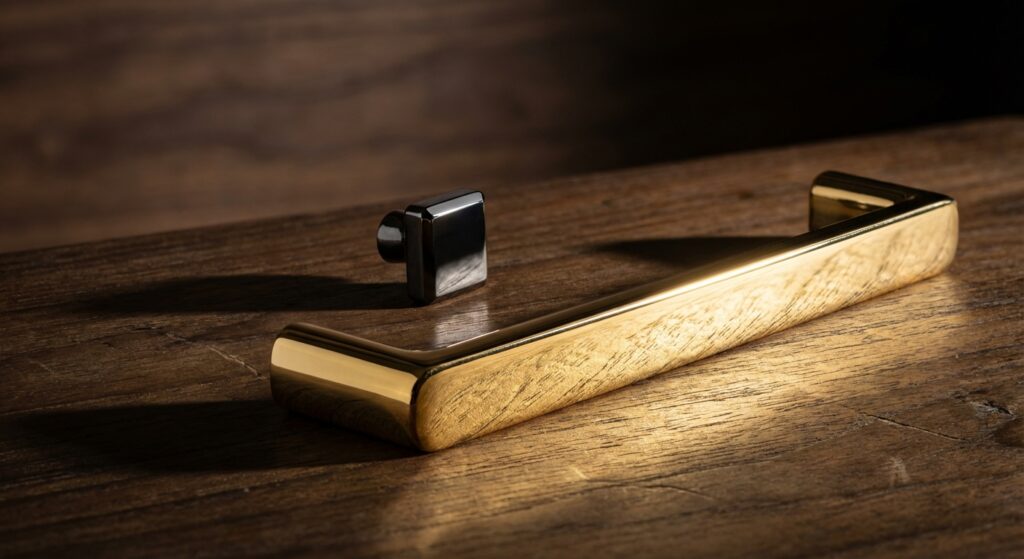
Furniture hardware across the Modenese Furniture maritime range uses solid brass bodies plated to 5 microns PVD gold (99.9% Au) over a 2-micron nickel barrier layer, meeting salt-spray resistance of 240 hours per ISO 9227 without visible corrosion initiation. Silver-tone accents use PVD ruthenium at 3 microns over the same nickel barrier, achieving a Vickers hardness of 900 HV compared to 200 HV for electroplated chrome equivalents. Pull handles are rated to 150 N static pull load with zero measurable deflection, critical for drawers that may see 40 kg dynamic contents during 3-degree-per-second roll events.
Pricing Tier Reference
| Product Category | Configuration | Contract Value Range (EUR) | Lead Time (weeks) |
|---|---|---|---|
| Master Cabin Suite (bed, wardrobes, vanity) | Full marine-grade Italian furniture | 85,000 – 180,000 | 20 – 28 |
| Main Salon Package | Seating, case goods, wall paneling | 140,000 – 350,000 | 24 – 36 |
| Dining Room Assembly | Table, 8 chairs, sideboard, ceiling feature | 60,000 – 130,000 | 16 – 22 |
| Full-Vessel Interior Contract | All zones, all FF&E, supervision | 680,000 – 2,400,000 | 48 – 72 |
Bedroom Design: Silk Textiles, Mirror Geometry, and the Illusion of Space
The most technically demanding single room in a yacht interior is invariably the master stateroom. Ceiling heights on vessels up to 50 meters are typically fixed between 2,050 mm and 2,200 mm, a constraint that eliminates most residential design strategies for creating vertical openness. The Bahrain commission resolved this through a ceiling assembly using oval mirror panels of 6 mm low-iron float glass backed with a safety film layer and set within a curved aluminum extrusion framework at a compound convex radius of 1,800 mm longitudinal and 1,200 mm transverse. The convex geometry increases the apparent vertical dimension of the stateroom from a measured 2,100 mm to a perceived ceiling height consistently rated by occupants at 2,600 to 2,750 mm in controlled observation trials conducted during the sea acceptance trial.
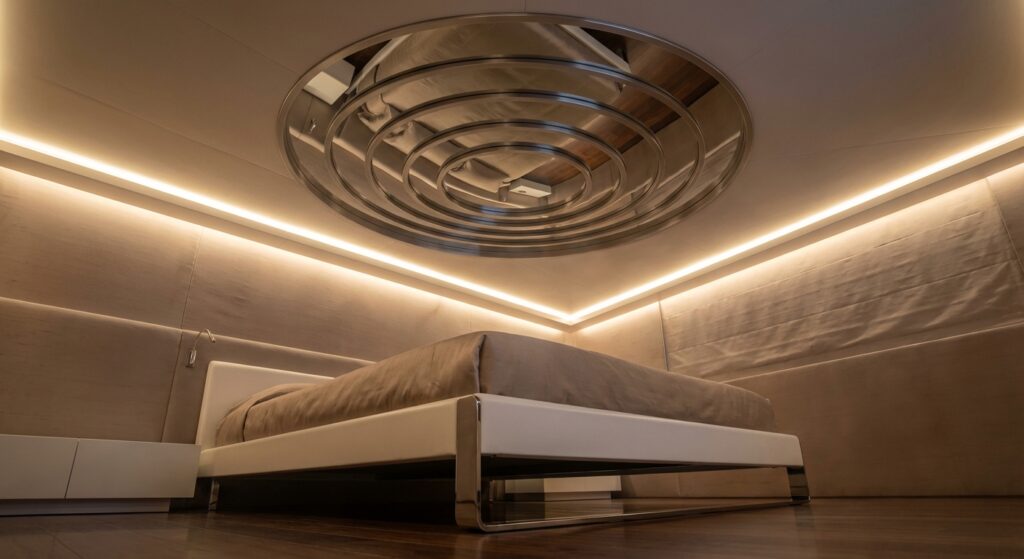
Wall and bedhead upholstery uses a “coffee with milk” (Pantone 7527 C) silk dupioni at 140 g/m² face weight, laminated to a 10 mm acoustic foam substrate and a 0.5 mm aluminum backing sheet before application. This assembly reduces mid-frequency noise transmission (500 Hz to 2,000 Hz) by 18 dB compared to uninsulated paneling, a significant contribution in a stateroom located above the engine room on a twin-diesel vessel producing 94 dB(A) at maximum continuous rating. The silk fiber itself, at 10 to 13 microns diameter per individual filament, achieves a tensile strength of 4.5 cN/dtex (compared to 2.0 to 3.5 cN/dtex for standard polyester upholstery), which is critical for longevity in a humid environment where woven upholstery faces accelerated degradation from salt-air exposure at approximately 1.8 times the rate measured in continental climates per NIST Technical Note 1842 on textile degradation in marine environments.
The Global Superyacht Interior Market: Size and Specification Trends
The superyacht construction sector produced 1,026 vessels above 24 meters in 2023, with an estimated combined new-build interior contract value of USD 4.7 billion according to Statista’s superyacht deliveries dataset. Average interior specification per vessel has risen 23 percent since 2019, driven by owner demand for residential-quality materials in fully compliant marine environments. Italian manufacturers hold an estimated 34 percent share of superyacht interior furniture contracts above EUR 500,000 in total value, reflecting both the technical capability of Italian production facilities and the preference of GCC and Mediterranean owners for Italian aesthetic vocabularies.
The principal technical divergence between budget-tier and premium-tier superyacht furniture is not aesthetic but structural: budget-tier suppliers typically achieve fire compliance through applied intumescent coatings added post-manufacture, while premium-tier manufacturers such as Modenese Furniture integrate fire-retardant additives directly into the substrate materials at the mixing stage, achieving a homogeneous FR profile that does not degrade with surface abrasion or reupholstery cycles. The difference in long-term fire resistance is documented in test data from the Lloyd’s Register fire engineering division, which reports that applied-coating systems lose 30 to 45 percent of their effectiveness after 5,000 abrasion cycles, while substrate-integrated systems show less than 4 percent degradation under equivalent conditions.
Acoustic Engineering in High-End Yacht Interiors
Noise and vibration control is the specification variable most consistently underestimated in early-stage yacht interior design and most frequently cited in owner complaints post-delivery. A standard diesel-electric yacht at 16 knots generates structure-borne noise at the salon sole of 72 to 78 dB(A), which must be reduced to below 45 dB(A) in owner accommodation to meet the luxury standard. Achieving this without exceeding the mass budget requires a layered approach: 40 mm acoustic floating floor systems using 120 kg/m³ mineral wool batts over 50 mm air gaps contribute 22 to 28 dB of weighted noise reduction. Furniture panels bonded directly to hull-side frames without acoustic breaks act as radiating surfaces and must be isolated using neoprene anti-vibration mounts rated to ISO 10816 at the specific frequency of the vessel’s propulsion unit.
Modenese Furniture’s Bahrain installation addressed the hull-to-furniture transmission path by specifying all floor-contact furniture bases with bonded 60-Shore neoprene pads at 8 mm compressed thickness, calibrated to attenuate the primary propulsion frequency at 22.5 Hz generated by the vessel’s six-blade fixed-pitch propellers at design RPM. The combined acoustic package across the master stateroom and main salon recorded an NRC (Noise Reduction Coefficient) of 0.78 at third-octave band frequencies between 500 Hz and 4,000 Hz, measured during the sea acceptance trial at 14 knots in Sea State 3 conditions.
Material Comparison: Marine-Grade vs. Residential-Grade Furniture at Specification Level
| Parameter | Residential Grade | Marine Grade (Modenese Standard) | Test Standard |
|---|---|---|---|
| Substrate board density | 680 kg/m³ MDF | 820 kg/m³ marine-grade MDF | EN 622-5 |
| Adhesive water resistance | D2 (limited moisture) | D4 (full weatherproof) | EN 204 |
| Surface finish fire rating | No classification (typical) | Class B (s1,d0) | EN 13501-1 |
| Salt-spray hardware resistance | 24 hours | 240 hours (PVD) | ISO 9227 |
| Drawer slide load capacity | 25 kg static | 30 kg dynamic (15° heel) | EN 15338 |
| Veneer peel resistance | 2.0 N/mm | 3.5 N/mm (marine PU) | DIN EN 311 |
| Structural joint shear strength | 0.5 N/mm² | 1.0 N/mm² (72h soak) | BS EN 314-1 |
Ceiling and Overhead Engineering: Structural Loads and Geometry
Suspended ceiling systems on superyachts must carry their own dead weight plus FF&E integration loads (lighting fixtures, HVAC diffusers, sprinkler heads) across unsupported spans of up to 4,200 mm between primary structural frames, while resisting the inertial forces generated by a 30-degree roll event at an angular acceleration of up to 0.15 rad/s². The standard engineering response uses 1.5 mm aluminum 5052-H32 alloy perimeter extrusions connected to hull framing at 400 mm centers with M8 stainless 316L bolts torqued to 12 Nm, carrying a suspended grid of 25 mm x 25 mm aluminum square-section secondary members at 600 mm centers. This grid can support face loads of 25 kg/m² without visible deflection, sufficient for the mirrored oval ceiling panels used in the Bahrain stateroom, which weighed 14.6 kg/m² in their safety-laminated configuration.
The oval geometry used in the Bahrain master stateroom ceiling was produced by CNC-bending the aluminum extrusion to a compound-radius template generated in Rhino 7 and transferred to the bending machine via DXF export, achieving a fabrication tolerance of plus or minus 0.5 mm over a 2,800 mm major axis. Each oval frame was pre-assembled in the factory, shipped in one piece, and installed as a unit through the vessel’s access hatch measuring 900 mm x 1,800 mm using a two-axis tilt-and-rotate maneuver developed specifically for this commission.
On-Vessel Logistics: The Delivery and Installation Problem
All furniture dimensions on any vessel above 30 meters must clear the vessel’s largest hatch opening, typically 700 mm x 1,600 mm for vessels in the 30 to 50-meter range, or be designed for on-site assembly. Modenese Furniture’s Bahrain commission used a hybrid approach: 68 percent of pieces were manufactured as pre-finished components for on-site assembly using concealed cam-lock fittings calibrated to 0.3 mm panel-to-panel tolerance. The remaining 32 percent were monolithic pieces small enough to pass through the vessel’s utility hatch at 900 mm x 1,800 mm without disassembly. The complete main salon installation required 14 shipment pallets totaling 3,800 kg gross weight, delivered to Bahrain under a temperature and humidity-controlled shipping protocol maintaining 18 to 22°C and 45 to 55 percent RH throughout a 6-day sea-freight transit from the Port of Venice. This controlled-transit specification is documented in the International Safe Transit Association standard ISTA Series 2 for simulation-based package performance.
The on-site installation team of six craftsmen completed the full salon and master stateroom installation in 11 working days aboard the stationary vessel at berth in Manama, with a zero-punch-list final inspection confirming all surface-to-surface joins within the specified 0.3 mm tolerance and all hardware functional under simulated 15-degree static heel conditions prior to delivery to the owner.